May 27, 2009
Twitterific eats iPhone batteries for lunch
A few days ago, I noticed the iPhone started to lose power astonishingly fast. After checking out Apple's page on conserving battery power I reset the phone to factory settings, shut off Push, and set all "Fetch New Data" to Hourly.
Memory Info, a handy little app which shows what processes are active, along with precise battery power levels showed that that MobileMusicPlayer (iPod) was active even though nothing was playing, so at first I thought that might be the culprit.
However after systematically removing each application that wasn't absolutely critical, it turned out that Twitterific was the real cause. Perhaps I had it set up wrong, but I'd rather live without Twitter than without my iPhone, so it has been deleted. It's a battery hog!
May 20, 2009
Serious Games: References, Resources and Templates
References, Resources, Templates
References
Games and Education in General
- Ahdell, Rolf and Andresen, Guttorm. Games and simulations in workplace eLearning: How to align eLearning content with learner needs (Study that seems to show that Interactivity is the most significant contributor to engagement)
- Beasley, Nicola and Smyth, Keith. Expected and Actual Student Use of an Online Learning Environment: A Critical Analysis. Electronic Journal of ELearning. Vol. 2, No.2. (Not exactly game related, but it is an eye-opening study of how little even computer-savvy students will use online resources without some intervention)
- Crawford, Chris. "The Art of Computer Game Design". 1982.
- Gee, James Paul. Professor of Curriculum and Instruction in the School of Education at UW-Madison
- Helmer, John and Learning Light. Second Life and Virtual Worlds (pdf)
- Juul, Jesper Publications on games
- Lieberman, Debra. "What is a Game?". 2007.
- Linser, Roni and Ip, Albert . Imagining the World: The Case for Non-Rendered Virtuality - the Role Play Simulation Model by. Excellent article on Role Playing and sims.
- Magerko, Brian, et.al. Intelligent Adaptation of Digital Game-Based Learning (description of a game that attempts to adapt its goals and game-play to the style of the student)
- Oblinger, Diane "Games and Learning" EDUCAUSE Magazine
- Oblinger, Diane Slides from "The Net Generation as Harbingers for Change: Implications for Higher Education"
- O'Neil, Harold F. et. al. Classification of Learning Outcomes: Evidence from the Computer Games Literature. Curriculum Journal, Volume 16, Issue 4, December 2005. This is a metastudy which highlighted the relationship of instructional design to effective games and learning outcomes, and the importance of the role of affective learning.
- PIXELearning. What are 'Serious Games' and immersive learning simulations? Article Link , White Papers Article Link
- PIXELearning. White Papers
- Marc Prensky.com
- Serious Games Effectiveness Research A review of the research on the effectiveness of Serious Games
- Van Eck, Richard. Learning Through Gaming: Why Games in Education and the Workplace Make Sense (lots of research on effectiveness and best practices)
- Van Eck, Richard. "Digital Game-Based Learning: It's Not Just the Digital Natives Who Are Restless," EDUCAUSE Review, Vol. 41, No. 2."
- Vygotsky, Lev S. Mind in Society: Development of Higher Psychological Processes, p. 86
- see also: Wikipedia article on Zone of Proximal Development (contains many more references if you are interested in pursuing this)
- Wilson, Katherine A., et. al. "Relationships Between Game Attributes and Learning Outcomes: Review and Research Proposals".
Games and Healthcare Training
- Begg, Michael, et. al. Transforming Professional Healthcare Narratives into Structured Game-Informed-Learning Activities. Innovate, Aug/Sept. 2007 (The Labyrinth Virtual Patient-based project)
- Breslin, Paul and McGowan, Clem. Advanced computer simulation games help to transform healthcare and disaster preparedness.
- Eliane Alhadeff's blog page on Serious Games And The Art of Medical Interview
- Hanson, Dr. Margaret M. Literature Review of Virtual 3D Learning in Healthcare" Journal of Medical Internet Research.
- Imperial College, London. Game-based Learning for Virtual Patients in Second Life.
- Kleefeld, Eric. Video game technology could improve physician-patient interactions. 2005
- Medicine Meets Virtual Reality 17 (conference blog)
- Lafsky, Melissa. Can Training in Second Life Teach Doctors to Save Real Lives? Discover Magazine, July 16, 2009
- O'Leary, Sharon, et. al. Educational games in an
obstetrics and gynecology core curriculum. American Journal of
Obstetrics and Gynecology (2005) 193, 1848-51
- Scrafford, Sarah. Medical Games Preparing for Real Life
- Games for Health - a Del.icio.us list of links
Second Life
- Top 10: Virtual Medical Sites in Second Life
- SLHealthy: Wiki on Health and Healthcare in Second Life
- Patricia F. Anderson, Emerging Technologies Librarian, Health Sciences Libraries
Virtual Patient Standard and Applications
- Working with the Medbiquitous Virtual Patient Standard
- eViP Project Team. Case studies of the use of virtual patients
- Imperial College of London: Virtual Patients
- Toro-Troconis, Maria. Imperial College of London. Virtual World Watch Blog Archive
- Imperial College of London: Game-based Learning for Virtual Patients in Second Life
Pervasive Games
Games and Patient Education and Rehabilitation
- Alexander, Leigh. Grants Awarded For Inspiring Health Games Research. 2008. Kotaku.com
- Watters, Carolyn, et.al. Extending the Use of Games in Health Care (IEEE article pdf)
Resources
- Adobe Flash
- Adobe Captivate
- Microsoft Silverlight
- JW FLV player - scriptable media player
- Articulate Presenter
- Pulse! by Breakaway: an immersive virtual learning space for training health care professionals in clinical skills
- Second Life
- Open source Second Life-like grid
- Thinking Worlds
- MediSmart Nursing Education Resources
- General Game Design GameDev.net
- 50 Great Learning Tools & Video Games for Nurses & Health Professionals
- Quia.com: Subscription website where you can create games and activities
- Jefferson County Schools Powerpoint Game templates Includes "Are you smarter than a Fifth Grader, Password, Jeopardy, Wheel of Fortune, etc.
- Rationale and description of JCAHO Trivia game
- University of Michigan Medical School: Medical Gross Anatomy games and templates
- 50 Great Learning Tools & Video Games for Nurses & Health Professionals
- Matching game
- Flash cards
- Concentration game
- Word search puzzle
- Battleship
- Challenge board
- Columns activity
- Hangman game
- Jumbled words
- Ordered list activity
- Picture perfect activity
- Pop-ups
- Rags-to-riches game
- Scavenger hunt
- Cloze activity
- Patterns
Authoring Software for building games
Medical Simulation Games and Open Worlds
Nursing-specific
Templates and generators for Games
Quia.com and other game generator sites
Quia Web: educational tools and templates, hosted online. Reasonably priced.

Serious Games: Edutainment Examples
Example "Edutainment" games
These are a few of the medically-oriented "Edutainment"-style serious games that have been used in my institution. Although Edutainment is sometimes thought of as the poor stepchild of the Serious Games world, we've found these to be an inexpensive way to add some variety and interest to certain types of training.
Medical Gross Anatomy Games (University of Michigan Medical School)
If you need to train people in memorized facts, calculations, quick answers, etc., these can be an effective way to add some engagement to the process.
The engagement generated by the game need not be strictly relevant to the subject matter. Competition can add a lot of pull to inspire people to do more practice or focus harder.
In 2005, a team at the Medical School did a study using a Jeopardy game to teach medical students the basics of diagnosis and treatment of ectopic pregnancy. The conclusion of the published article states that although the two methods (lecture and game) were about equally effective, the students found the game more stimulating and interactive. As one of the key concepts of adult learning is active participation, they feel this type of activity is an improvement over passive lecture formats. A similar game from the Anatomy department is shown below.
Jeopardy-style games have been successfully used for quite a while at the Medical School, and they've put some of their game templates on the web for download:
University of Michigan Medical School Medical Gross Anatomy Games site


Blitzopoly
Blitzopoly, created by Kathy Pederson and Kristen VanDerelzen of UMHS's Infection Control Services Department, was aimed at training people about infection prevention during a sort of health fair for staff. Players would roll dice and move their piece. There were three case studies and a "Chance" square on each side. The case studies were repeated so it was likely all cases would be hit in the short time allowed for game play. Each case had answer
cards and players had to choose the best answer for each one.
The educators found that the game worked best with groups of 3 to 5 people. People would talk and discuss the answers. Players were given a short pre-game briefing on the topic of infection prevention. Playing the game emphasized and aided retention of the main points of the briefing. Besides the educational benefits, they found that the process of developing the game created its own social benefits to the department as well.

Blitzopoly game board


JCAHO Trivia
JCAHO Trivia was used to train staff in some of the required information they needed to know for a Joint Commission visit. There had also been many other types of instruction, and this was just one learning option available.

We decided that this game had to be asynchronous: in other words, users had to be able to log in day or night and participate, without worrying if anyone else was online to compete against. Since we wanted the training to continue for a few months, the content had to be kept fresh. Content had to be very easy to create and to load. We wanted to attract people to the game, so we capitalized on the competitiveness of our audience and divided the nurses up into teams, based on their units.

Another key element was there must be no downside to this game. Players must not be penalized for wrong answers - although we did try to give corrective feedback that would help them learn. Players could choose any of the 4 topics offered, so they could play in their comfort zone. We tried to make it so that every time they played they felt they were contributing toward their team's score. The real time scoreboards were especially effective in generating interest.

A lesson learned was that content is always the bottleneck. Providing high quality content was a challenge, particularly since so MUCH content was needed for this game.
However the game was extremely popular and players got attached to their teams and there was a lively team rivalry for several months.

Virtual Cart
This game (shown in a state of development) trains cardiac arrest teams in the location of each item within the crash cart. The learner is presented with an item to find. Clicking on the handles opens each drawer. Items are dragged to the target to be checked. If the correct item has been found, the student is rewarded in
some manner still to be determined, and another item is requested.
After 6 items the game ends.
Variations considered for different learning styles:
wins, sort of like in video games where you record your high scores
with your initials.
authentic room noises reaching a crescendo if the learner took too long
to find the item. Finally - flat line on the monitor!


Design: Steve Burdick, game development, Ellen Meiselman
Serious Games: Role Playing Games
Adapted from material contributed by Lisa Leutheuser

What is roleplaying?
Many corporate employees are familiar with some form of role-playing in the context of their job, such as communication skill building, customer service training, assertiveness training, etc. In most of these the participants play themselves, responding to scenarios in order to practice those scenarios and develop skills. Roleplaying can go far beyond that, and there are many contexts in which it can be used for both soft skills training and problem solving.
Roleplaying involves adopting a specific role to play out in the game. The role will frame the player's perspective in the game: it will define how they respond to the game environment. One one end of the roleplaying spectrum, each participant simply plays themselves, or on the other extreme, in the acting zone, players enact roles very different from their real selves with very different background and motivations.

Why use roles in a game?
A game isn't real life, so the consequences are low. The game provides a safe environment in which to explore an issue. Using "roles", a person may express ideas/opinions that they might otherwise feel too intimidated to say. "That's not my opinion; it's what this person in this role would think."

Changing purpose changes the game
- The purpose of your game, what your objectives are, will define or affect how roles in the game are used. If you are training process, real-life scenarios, or skills, then you will play roles that are very similar to yourself (or just play yourself). If your game is intended to explore communication issues, as opposed to communication skills, you may play different roles.
- An example is a police department and a fire department that were having trouble collaborating on emergencies. It was causing a lot of problems. Each side was pointing fingers at the other, and they were not able to develop an atmosphere of teamwork. So they played a game in which the police had to play the firemen and the firemen played police. Then they had to see how they would respond to an incident. In this way, they explored communication issues, exposed barriers that were preventing good collaboration, and it opened up a lot of communication between the teams and led to better teamwork.
- This kind of scenario can raise a lot of emotions and needs to be carefully managed.
Predictive modeling and "futuring"
- Imagining the World: The Case for Non-Rendered Virtuality - the Role Play Simulation Model
- Design of a role-playing game to study the trajectories of health care workers in an operating room DOI Bookmark: http://doi.acm.org/10.1145/1125451.1125658
- Creating Learning Opportunities Using an RPS Authoring Tool (Linser & Ip)
- Creating Learning Opportunities Using an RPS Authoring Tool (Linser & Ip)
- EJ330946 - Geriatrix: A Role-Playing Game. by Hoffman, Stephanie B.; And Others
- Lisa Leutheuser trained in the design and use of Role-playing games at the University of Michigan and also writes a blog at http://www.kitchenchick.com/
References
Serious Games: The relationship of game attributes to learning outcomes
The relationship of game attributes to learning outcomes
A group of researchers headed by Katherine Wilson has done a review of the literature about the effectiveness of serious games. They found that very hard evidence is available: most is anecdotal and suggestive, particularly with respect to which game elements promote which outcomes in learning. However the existing research is suggestive of relationships that could be the subject of future research. Wilson's group listed fourteen proposals for such research, which could be very useful as guidelines in designing learning games, even if they aren't scientifically proven.
The propositions are listed below:
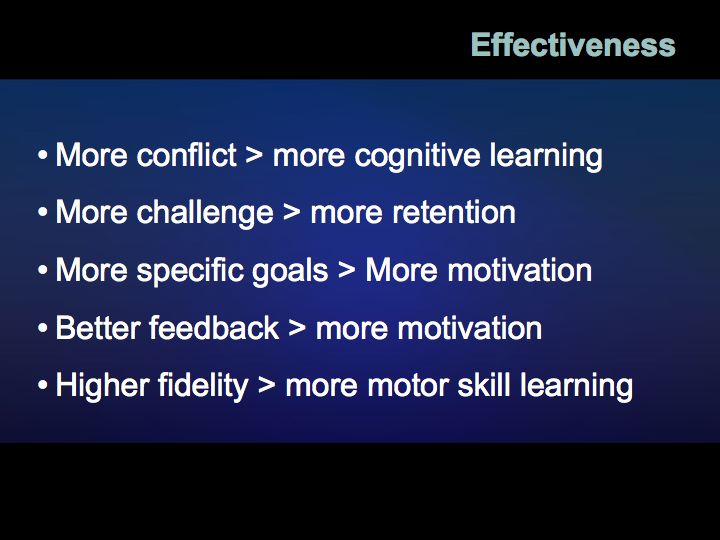
- The amount of conflict presented within a game will be positively related to cognitive learning (i.e., overall cognitive abilities).
- As the challenge feature in a game increases, so will declarative knowledge and learner’s retention of that knowledge. However, a point will be reached when too much challenge will hinder and decrease learning (i.e., an inverted U relationship).
- Increasing the adaptation feature in a game will result in an increase in a learner’s cognitive strategies.
- As representation (i.e., fidelity) of the task in a game increases, psychomotor skill learning will also increase but then level off.
- Automaticity set will increase as the level of fantasy in a game increases.
- Requiring learners to participate in their learning through interaction with the game (i.e., interaction, equipment) will result in improved skill-based learning.
- The amount of control given to learners will positively affect skill-based learning.
- The specificity of the rules/goals in a game is positively related to learner motivation.
- a: Learner motivation will increase as the level of endogenous fantasy and safety increase in a game.
b: The relationship between learner motivation and exogenous fantasy will be curvilinear as too little or too much will lead to decreased motivation. - Representation in a game (both physical and psychological) is positively related to learner motivation.
- Learner motivation is positively related to the level of mystery in a game.
- The relationship between motivation and challenge will be curvilinear in that too little or too much challenge will lead to decreased motivation.
- The specificity and immediacy of the feedback (i.e., assessment) is positively related to learner motivation and attitudinal valuing.
- The relationship between learners’ attitudinal value of training content and challenge will be curvilinear.
--Wilson, Katherine A., et. al.
- Relationships Between Game Attributes and Learning Outcomes by Wilson, Katherine A., et. al. from Simulation & Gaming, Vol. 40, No. 2, 217-266 (2009) DOI: 10.1177/1046878108321866
Serious Games: Simulations - how real is real enough?
Simulations: how real is real enough?
How realistic does a simulation have to be? The answer is: just high enough to achieve your specific learning objectives.

Many medical games have some simulation component as part of the game play. The idea of producing a simulation can be daunting because of the difficulty of accurately reproducing a "real" environment or situation. But if you consider the amount of realism actually needed to teach specific learning objectives, you may find that not only will a simplification
of reality do, it may be better than presenting a more realistic representation.
A simulation designer simplifies only as a concession to limited
resources. A game designer simplifies deliberately in order to focus
the player's attention on important factors. A game deliberately suppresses detail to accentuate the broader message that the designer wishes to present. ..." [Crawford, 1982]

Even in a fairly realistic simulation it is necessary to make choices about what components will get a less realistic treatment. In this surgical simulation from MySmartSimulations the use of surgical tools is greatly simplified, in favor of emphasizing procedural concepts.


Serious Games: Keys to Success
Keys to Success

Know your target audience. If some learners might benefit more from alternatives, provide them. Different learners will like different types of games, so you may need to provide more than one game, targeted to different audiences.
Choose a game that supports the learning objectives and content, but balance this with the requirements of game play. Focus in on specific objectives and outcomes as much as possible.
Failure is not a bad thing. Don't make the game too easy. Easy learning games do not produce good learning outcomes. Leaners are more likely to remember when things go wrong
Use competition and/or collaboration. Competition motivates learners. Collaboration is even better: it allows social learning that is effective in motivating behavioral change.
Test, test, test! Even simple edutainment games can have unexpected glitches. For example, a monopoly game that was targeted at teaching visiting nurses specific infection control techniques turned out to requuire knowledge the nurses did not have before starting the game. This was solved by holding a short briefing before starting the game, but pre-testing might uncover this type of issue.
Consider having learners create their own games. In several reports, this was mentioned as one of the most useful exercises involving games, probably because it requires the student to think through the subject thoroughly.
- Serious Gains from Serious Games by Enspire Learning
- Ahdell, Rolf and Andresen, Guttorm. Games and simulations in workplace eLearning: How to align eLearning content with learner needs (Study that seems to show that Interactivity is the most significant contributor to engagement)
- O'Neil, Harold F. et. al. Classification of Learning Outcomes: Evidence from the Computer Games Literature. Curriculum Journal, Volume 16, Issue 4, December 2005. This is a metastudy which highlighted the relationship of instructional design to effective
- Wilson, Katherine A., et. al. "Relationships Between Game Attributes and Learning Outcomes: Review and Research Proposals".
- Collaborative games: Lessons learned from board games by Jose Zagal, et.al.
Serious Games: Potential problems with using serious games
Potential problems with using serious games
"Although games can be effective learning environments, not all games are effective, nor are all games educational. Similarly, not all games are good for all learners or for all learning outcomes."
- Diana Oblinger, 2006
- When deciding to use a game for training, it's important to clearly state your learning objectives and to determine exactly what advantages the game will provide. If the game is too easy or too hard, or does not focus on the objectives, it may simply waste the learners' time. Depending on the type of game you intend to use, you may need to go through a substantial testing phase to ensure success.
- Playing the game becomes more important than the learning
- Cost of producing a game exceeds learning return on investment
- Game takes a long time to produce and is ineffective at training
- Game too easy or too hard
- Learning curve to start playing game is too high for the target audience
- Learner remembers game but not content
- Other learning tools may be more effective
- Information incomplete or inaccurate in the game
- The game is too difficult to maintain or keep up to date
Some of the possible issues to watch out for:
Problems with online environments in general
When designing any learning activity it's important to consider the learning styles of your audience. Some populations tend to be highly motivated and self-directed, but some will have trouble with the non-linear form of learning that can be characteristic of online learning environments. Some may simply be resistant to using a game, so when it is reasonable to provide alternatives, you may want to consider doing so.
The quote below is from an article in the Electronic Journal of e-Learning, and represents the results of studies that are a few years old. It is possible that since this article was published, students' behavior has changed substantially, but in business training the learner population is often older and may not take complete advantage of online resources.From Expected and Actual Student Use of an Online Learning Environment: A Critical Analysis by Nicola Beasley and Keith Smyth
(Link)
Despite the claims that can be made regarding the educational potential of OLEs, it is becoming apparent that some students, often including those who value what the learning environment has to offer, do not interact with them in a manner conducive to fully experiencing the benefits.
Many students have a tendency to procrastinate rather than exploiting the opportunity for self-paced learning that exists online, which typically leads to them 'falling behind' (Hiltz 1997). It is also common to find that much studying actually occurs offline, and is largely based around working with printed copies of material (Crook 1997; Ward & Newlands 1998). Furthermore, research into the influence of learner differences in online contexts tends to indicate that only a minority of more focused or active students will fully utilise the materials and tools at their disposal, while the majority limit themselves to working with core materials and only satisfy the basic
requirements for interacting with other features of their environments (Light et. al. 1997; Gibbs 1999; Karuppan 2001). Finally, in relation to online communication, it is widely accepted that students will rarely participate in
asynchronous discussion or collaboration simply because a facility for this has been provided (Tolmie & Boyle 2000; Salmon 2002).
Serious Games: Why use games for training?
Why use games for training?
"Without motivation there is no learning"-James Paul Gee
"If a learner is motivated, there's no stopping him [or her]"
-Will Wright
Why is there so much excitement around the idea of using games for workplace training? Simply put, games have some advantages that make them exceptionally suited for training in certain situations.
One word: Engagement!
You probably have some sense of how compelling, if not addictive, games can be. Wouldn't it be nice to be able to borrow some of the stickiness and pull that a game creates for practicing and perfecting real-life skills? The engagement that games produce is hard to match with other training methods.
If we can determine what features make games compelling, we can more
easily spot opportunities to "kick it up a notch" and generate some of that same stickiness in our training programs. Competition and challenge can help provide motivation to meet learning goals even if they are only tangentially related. Trivia games, jeopardy games, or board games where you move a little farther toward a goal by solving a puzzle are all examples of this.
If the game structure is directly related to the learning objectives, as in a simulation, it can be even more effective, since it combines the challenge of a game with a safe place to practice real-life skills.
Games feel "safe"
Games provide a safe place to practice, where learners know they will not be penalized or stigmatized for their mistakes. There is also a low physical risk to the learner, and of course there is no risk to patients or others. Playing games can be a safe place to try different approaches, to experiment, and most importantly to make mistakes and to fail.
Reduce Cost and Complexity of training
-
The cost of developing even a very expensive game can still be lower than cost of other types of training
Enhance Transparency, Feedback
It is often possible for the educator to watch or replay complex learner actions during the game, something that would be difficult to achieve in a real-life demo.
"Situated cognition"
Richard Van Eck, a noted game researcher, points out the contextual nature of digital game-based learning:
"Games are effective partly because the learning takes place within a meaningful (to the game) context. What you must learn is directly related to the environment in which you learn and demonstrate it; thus, the learning is not only relevant but applied and practiced within that context.
... Researchers refer to this principle as situated cognition
and have demonstrated its effectiveness in many studies over the last fifteen years. Researchers have also pointed out that play is a primary socialization and learning mechanism common to all human cultures and many animal species. Lions do not learn to hunt through direct instruction but through modeling and play.8 Games, clearly, make use of the principle of play as an instructional strategy."
Serious Games: discussion of the Virtual Knee Surgery game
Virtual Knee Surgery is designed to teach high school students some of the
concepts and steps in a knee replacement procedure. It is fairly simplistic but demonstrates some typical game structures and objectives well. You can try the real Virtual Knee Surgery game here, or just follow along with some of the screenshots below.

Your first task is to check the patient's vital signs, comparing them to healthy ranges:

After viewing X-rays, you are asked to mark the correct knee. I
found I actually had to stop and think for a moment, a great
demonstration of how easy it could be to get the site wrong. The tool
interface is a nice solution to the problem of simulating skills
online. This game does just enough to get the point across.
You click the right tool...

Then draw your initials on the knee.

After the patient is draped, and the incision is marked, you make the incision by dragging a scalpel down the marked incision line. The scalpel moves as if it is on rails, which eliminates the need for manual dexterity with the mouse.

On the interactivity spectrum, the virtual knee surgery falls nearer to the low end of the scale, similar to a story or movie. From one try to the next there is very little change in the way the game plays out.
This is an example of a "Progression" game. You are presented with a series of challenges, where all the options and solutions have been pre-designed by the games developers. You can't do anything they did not explicitly create.
Although this game leans more toward a script or narrative because your interactions cannot change the story very much, it is a great example of how engaging even a fairly simple game can be.Despite its apparent simplicity, this game keeps the player's interest and teaches some of the steps and associated concepts (like sterility, how the prostheses are fitted, vital sign ranges, etc.) of surgery and knee surgery in particular.
The Virtual Knee Surgery game demonstrates some contextual learning. The player is given a little scrap of new knowledge, which can be used immediately, then another for the next step. You have very limited options in how to use the new ideas, so you may not understand or retain as much as if you could try things out and fail some of the time.
In general, adult Learners tend to prefer more control over the speed and direction of the learning process, so that is something to keep in mind for designing learning games.
You will probably notice that there is really only one path through this game. If you make the wrong choice, you are soon steered back to the correct path again, with corrective feedback as shown in the diagram below:

You might recognize the similarity between this simple branching and the decision trees healthcare workers often use to describe their thinking processes and procedures.
For example, this was a decision tree used a few years ago for managing cases that might call for restraint. Game developers working to create scenario based games, have found that medical educators are very well equipped to work on these types of games - it's a good fit.
Medical educators are used to presenting cases as complex, branching narratives and they often invite interaction requiring critical thinking and understanding from learners.

- Transforming Professional Healthcare Narratives into Structured Game-Informed-Learning Activities by Michael Begg, Rachel Ellaway, David Dewhurst, and Hamish Macleod
Serious Games: Online game terminology
- An Open World game is one where players can freely roam a virtual world. Usually the
term is used to describe a game that has objectives and a storyline, but is sometimes used to describe completely open-ended virtual worlds like Second Life. - Non-Linear gameplay: Players are presented with challenges that can be completed in more than one order. Nonlinear sequencing may consist of multiple entire plot sequences to complete the game, subplots or small branches off the main plot.
- Sandbox games have no predefined story. An example of this might be the Sims, where the player controls the storyline.
- Persistent worlds are game-worlds that continue to develop and evolve even when the player is signed off.
- Pervasive games are games that overlay or are tightly interwoven with the everyday life of the player, often using mobile devices or other technology to provide the link between the player and the game world. Some of the types of pervasive games include: treasure hunts, alternate reality games, pervasive live action role-playing games, urban adventure games, smart street sports, and massively multiplayer mobile games.
- Integrated Project of Pervasive Games
- Jane McGonigal: Writings
Jane McGonigal is a well-known evangelist for pervasive games that are designed to have a positive impact on the real world.
Serious Games: The Virtual Patient specification
The Virtual Patient - a common standard for medical simulations
The Virtual Patient specification was developed to take advantage of the natural affinity for the branching narrative style of much of medical education. The Virtual Patient is a common standard by which patient cases can be structured in a manner that can be read by many game and simulation systems.
A virtual patient represents whichever characteristics of the patient are relevant to the current educational context.
The VP format contains these segments:
- Patient History
- Investigations
- Differential Diagnosis
- Final Diagnosis
This is specified using a standardized document structure for the description of the patient called CaseML .
What software can utilize Virtual Patients?

The Labyrinth system, developed at University of Edinburgh is one example of an elegant use of the standard without attempting high fidelity realism.

The Labyrinth system uses mostly text-based interaction, along with beeper windows, test results and various other messages and alerts that pop up to provide a realistic experience (See below).

Moving up the realism scale a little, is this first phase of a project from the Imperial College of Medicine.

- Begg, Michael, et. al. Transforming Professional Healthcare Narratives into Structured Game-Informed-Learning Activities. Innovate, Aug/Sept. 2007 (The Labyrinth Virtual Patient-based project)
- Working with the Medbiquitous Virtual Patient Standard
- eViP Project Team. Case studies of the use of virtual patients
- Imperial College of London: Virtual Patients
- Toro-Troconis, Maria. Imperial College of London. Virtual World Watch Blog Archive
- Imperial College of London: Game-based Learning for Virtual Patients in Second Life
Serious Games: Attributes of games
Attributes of games
Games of emergence vs. games of progression
- Jesper Juul notes that games, in particular computer games, present challenge to the player in one of two ways: "Emergence" (simple rules combining into interesting variation, and "Progression" (serially introduced challenges).
- Emergence: a number of simple rules combining to form interesting variation
- Progression: separate challenges presented serially

Chess, board games, card games and strategy games are good examples of the emergence type of game. A small number of rules combine to create enormous variation. These games tend to be played over and over, with infinite strategies.
Progression games present a fixed sequence of events, with each challenge requiring a predefined set of actions to complete it. The old game Myst was a good example of this type, as are many adventure games.
Interactivity

Representation

Challenge
"Challenge" can mean very different things depending on the game. It can be the mystery to be unraveled, a problem to be solved, or it can involve more perceived conflict and risk to the player: beating the clock, defeating opponents, or keeping your own character alive in the face of multiple threats. It is possible to have a very challenging game with little perceived in-game risk, but usually conflict and competition come into play.

- Ahdell, Rolf and Andresen, Guttorm. Games and simulations in workplace eLearning: How to align eLearning content with learner needs (Study that seems to show that Interactivity is the most significant contributor to engagement)
The Open and the Closed: Games of Emergence and Games of Progression
- Crawford, Chris. "The Art of Computer Game Design". 1982.
- Wilson, Katherine A., et. al. "Relationships Between Game Attributes and Learning Outcomes: Review and Research Proposals".
- Some researchers have attempted to list a complete taxonomy of types of games (too many to list here, but they can be found at Serious Games.org).
Serious Games: What is a game?
What is a game?
Note: This series of posts is from the handout for a talk on serious games, given at UMHS on May 12.

We all have an idea of what a game is, but it is not so easy to define precisely what makes games different from other activities. No definition of games is entirely complete, but we can approach an understanding by considering games in relation to similar activities, such as reading stories, watching movies, playing with toys, solving puzzles, and so on, and try to see where the significant differences lie.
Stories, games, toys, puzzles, races, etc. all have some attributes in common, but the proportions of those attributes make some activities more gamelike. Thinking about the role of attributes such as interactivity, representation, challenge, and risk can help us understand the nature of a particular learning game, what types of learning objectives it might be most effectively used for, and what kind of learner might benefit from it.
With these limits in mind, one good place to start is Debra Lieberman's definition: "A rule-based activity involving challenge to reach a goal. Rules, Challenge and Goal are themselves very flexible terms, but they do set up a structure we can work within. We'll be discussing these and other attributes, as well as which attributes seem to most affect learning.
Some game researchers consider the game's rules as the key difference between a game and other forms of narrative, but I think, particularly in health care, the narrative has a privileged role.
Debra Lieberman has served on the advisory board for Games for Health for the past two years. Her extensive expertise in this area has been invaluable in shaping this emerging field. Debra Lieberman is a lecturer in the Department of Communication and a researcher in the Institute for Social, Behavioral, and Economic Research (ISBER) at the University of California, Santa Barbara.
May 18, 2009
Set duration in Windows Media
A quick way to create shorter clips out of longer ones without video editing: set the Starttime and Duration parameters in the ASX file.
Example ASX file:
<ASX version = "3.0">

  <Title>the title of the video/s</Title>

  <Entry>

  <StartTime Value="00:09:36.00" />

  <Ref href = "mms://myvideoserver.com/myvideo.wmv" />

  <DURATION value="00:00:05.00"/>

  </Entry>

  </ASX>
May 13, 2009
Serious Games presentation
These slides are from an inservice I gave the other day on the attributes and effectiveness of Serious Games. Thesea are mostly pictures so you will probably get more from viewing the narrated, captioned version of the presentation HERE
May 8, 2009
Music: why not a finger-sensing keyboard?
Electronic keyboards like the Yamaha Motif or Korg M50 often have a "Split" feature, allowing different patches to be assigned to different sections. For example, the bottom 18 or 20 keys can be assigned to a bass patch, leaving the rest of the keys assigned to an electric piano sound. These splits allow not just the patch to change, but the pitches as well. For example the bottom keys can sound an octave lower than they ordinarily would.
Small keyboards often have buttons that shift the octave to the left or right on the fly, effectively increasing the number of keys without the weight.
There is another split type that is possible nowadays but apparently no manufacturer has done it yet. What if the patch or pitch range were assigned to each key in real time by which finger or which hand touched the key?

This would require some type of signalling device on finger or hand that would be instantly recognized by the keyboard. Of course the device would need to be very small and non-interfering with the sense of touch or movements of the fingers. The speed of the sensors involved would have to be quite rapid as well.
What could you do with this? Well, if you are a good pianist, you could play contrapuntal melodies, with each voice in a different instrument.
Or, if you set the keyboard to recognize the left hand as the bass, any key touched by the left hand could sound an octave lower than when touched by the right. Even when the hands crossed, the voices would maintain their separation.
This would make it possible to use much smaller, lighter keyboards to get the full range of notes, or multitimbral setups that ordinarily take multiple manuals could be done with one.

May 6, 2009
Progress in the fight against Hospital Acquired Infections
The problem:
Over the last few years, public attention has been focused increasingly on the problem of nosocomial or hospital acquired infections (HAI's). Why is there so much concern? A study by the CDC published in the March/April 2007 issue of the journal Public Health Reports, estimated that 1.7 million hospital patients per year ― 4.5 of every 100 admissions ― become infected, causing or contributing to the deaths of nearly 100,000 people per year. (IHI.org) 100,000 people per year is about 1/5 of the total deaths from cancer per year in the US, or about the same as the total stroke or accidental deaths. Or, another way to understand the size of this number, picture the population of South Bend Indiana, dying every year of mostly preventable causes. This is an epidemic.
Hospital acquired infections may be the sixth leading cause of death, but many people do survive, only to experience long, difficult recoveries, sometimes with devastating surgeries, or permanent disability. Each time a patient becomes infected it adds an average of $30,000.00 to the charges for their hospital stay, money that is no longer reimbursed by Medicare. So it is not surprising that there are many initiatives seeking to reduce the incidence of these infections.
Burn patients, patients who are on ventilators, certain types of surgery patient particularly those with diabetes, and patients with a central line inserted are most likely to get these types of infections, but they are an increasing problem for all sorts of patients. In 2008, the US Government Accounting Office issued several reports calling for a greater role for the Department of Health and Human Services to obtain reliable data on HAI's from inpatient settings and outpatient procedures and to prioritize prevention practices. Link and Link
What works to prevent these infections?
Researchers are working to find effective means of reducing the incidence of nosocomial infections. Some of the best practices coming out of recent studies include
- Following the infection control policies already in place, like washing hands, improper sterilization of equipment, etc.
- The incidence of ventilator associated pneumonia (VAP) can be reduced by 50% if patients' teeth are brushed 3 times a day, even if they are unconscious. Link
- Bathing intensive care patients daily with antibacterial (chlorhexidine) reduces catheter-associated bloodstream infections. Link
- Performing laparoscopic surgery instead of open incision procedures Link
- All the little places we touch without thinking: pens, paper, wristwatches, doctor's white coats, sink taps, bed rails, etc. have to be looked at as sources of cross-contamination.
But some of the changes that would help the most are very difficult to accomplish. These involve changing the physical configuration of hospitals and health care settings. Research suggests that single-patient rooms can reduce infection rates up to 45%. This can require new building or expensive remodelling. Or, simply halving the bed space in a given unit. I've seen this done in some facilities, where they appear to have decided after the fact and given each patient a really big room. In some older hospitals, handwashing sinks are located far from the patients, so staff either wash less than they should or use the patient bathroom, a source of contamination. Clean wheelchairs, walkers and canes must be stored apart from used supplies - this requires more space. Link
The American Institute of Architects' 2006 Guidelines for Design and Construction of Health Care Facilities lists Single-bed rooms as the minimum standard for typical nursing units in general hospitals, based on US federal guidelines. Link
Initiatives currently underway
- The IHI has targeted some types of infections for zeroing out. They are focusing on infections that can be reduced by following evidence-based procedures or by simply not violating the policies that are already in place. IHI.org
- The Department of Health and Human Services has made it a national priority to increase transparency of healthcare so consumers can make informed decisions. This means better reporting about quality of care. Link
- A conference on Healthcare Transparency and Patient Advocacy will be held in Lexington, Kentucky on November 20, 2009. According to this article, a key goal of the conference is to make information on hospital-acquired infections more widely available to the public.
- At least 22 states have enacted laws requiring public disclosure of hospital acquired infections. A good summary of the current laws is available on AboutHealthTransparency.org. Link
- A few of the new hospital buildings being built with all or mostly private rooms:
- St. Mary Medical Center in Long Beach, CA Link
- Rockingham Memorial Hospital Link
- Medicare Hospital-Acquired Conditions Initiative Link
- Dublin Methodist Hospital, near Columbus, Ohio Link
- Simi Valley Hospital, Simi Valley, CA Link
- Children's Hospital, Pittsburgh, PA Link
- Kaiser Permanente's new Santa Clara hospital Link
- Mayo Eugenio Litta Children's Hospital in Scottsdale, Arizona Link
- Henry Ford West Bloomfield Hospital in Michigan Link
The public transparency initiatives will probably do the most to accelerate progress, along with hospital's new understanding of the savings possible when infections are reduced.
by RICHARD A. VAN ENK, PHD, CIC, Director of Infection Control and Epidemiology at Bronson Methodist Hospital