October 9, 2007
The Cuttlefish: An Intelligent Cephalopod
Before I visited the Georgia Aquarium, most of what I used to know about cuttlefish included the fact that they can be purchased neatly packaged in dried chewy form in Japanese groceries. So, I was very surprised when I first met one face to face in the Georgia Aquarium and realized they are remarkably intelligent creatures.
Cuttlefish are invariably curious about people, and will come up and try to get a better look if you catch their eye. They are precision swimmers, able to hover motionless near an object of interest by rippling their skirt of fins, only to suddenly jet off in another direction using their funnel siphon when they have seen enough.
They are equally curious about other cuttlefish - even images of cuttlefish - as the video below by Brian Leahy demonstrates. In the middle of the video, the videographer turns the camera's display around to face the nearby cuttlefish which inspires an immediate darkening response, and causes all the other cuttlefish in the tank to start moving purposefully toward the camera.
An article by Brenna Lorenz describes an encounter with cuttlefish and humans who had the idea to match the gestures made by the cuttlefish with their tentacles. The Cuttlefish of Sentosa (Sentient Cephalopods), by Brenna Lorenz
In a similar vein, a comment on a Reddit story on a troublesome octopus describes how the author, Saydrah, used hand-signals to communicate to a tank full of cuttlefish:
"...Okay, I was 13 and on a school trip to the Monterrey Bay Aquarium. Each kid in the class had been assigned a sea critter to study, and mine was the Cuttlefish. I realized while writing my report that in almost every photo of a cuttlefish where it was clear that it could see the person taking the photo, it held its tentacles like this. (click here) I was also learning some sign language at the time, and it clicked: It's a greeting. At least, that was my theory, and as soon as I got to the aquarium I sought out the cuttlefish to test it. There were 16 cuttlefish in the tank. I asked a staff member about them, and she said, "I know we put 16 in there, but they blend in so well we haven't seen more than 6 at a time since then. There haven't been any bodies, so I presume there are still 16." At first I could spot two, camouflaged on rocks. I went up to the tank, knelt down, and held my fingers in the greeting pose from the photos. Incidentally, cuttlefish have 10 tentacles, two of which are set back and only shoot out to grab prey. Much like 10 fingers with two set back thumbs. It's easy to make your hands into a recognizably cuttlefish like shape. With 10 minutes, I had 13 cuttlefish lined up at the front of the tank doing the greeting pose back at me. My teacher got all this on video, and a couple staff members came over and were floored at the sight. They started doing the sign language at the cuttlefish too, and the cuttlefish responded to them also. Some of them also changed color, which obviously I couldn't mimic, and made different tentacle poses, which I tried to repeat back to them. After a couple minutes, one smallish cuttlefish turned red, grabbed a shrimp that was in the tank as a snack for the cuttles, and pushed the shrimp up against the glass in front of my hands. It seemed to be offering it to me. Then a larger cuttlefish turned white, grabbed the shrimp from the smaller one, and the big cuttlefish then repeated the effort to push it through the glass to me! The small cuttlefish turned gravel patterned, shot a jet of water out, and went to hide behind a tank decoration.
from comment by Saydrah on Reddit
The ability of cuttlefish to instantly mimic the color and texture of their environment, particularly the area underneath them, is well known but little understood. They use a layer of chromatophores and a layer of iridiphores (reflective cells) [Meet the Cuttlefish] which are revealed when chromatophores contract as well as detailed muscular control to create visual and textural illusions.
The textures and colors they imitate are so complex that it led me to wonder if cuttlefish use only their eyes as the sole inputs for processing visual information. In other words, if their eyes are covered, can they still mimic their surroundings? Several recent articles present evidence that their eyes are indeed the main sensors. Cuttlefish eyes have been determined to be colorblind, but are sensitive to the orientation of polarization of incoming light. One study determined that contrast is one of the main visual cues used to determine the pattern of camouflage.

Cuttlefish mimicking a net trap
(I don't have an attribution for this photo yet)
Their visual patterning is used for communication as well as camouflage, and even sometimes for hypnotizing their prey [ A Dazzling Show.]
These visual signals have been analyzed and found to have a signal capacity of approximately 3 bits per signal - enough for some primitive communication, if not an actual language in the human sense of the word.
Cuttlefish are Cephalopods and belong to the superorder Decapodiformes which includes all species with ten limbs. (8 arms and 2 tentacles.)
More information:
Cuttlefish Taxonomy:
- Kingdom: Animalia
- Phylum: Mollusca
- Class: Cephalopoda
- Subclass: Coleoidea
- Superorder: Decapodiformes
- Order: Sepiida
- Order: Sepiida
- Superorder: Decapodiformes
- Subclass: Coleoidea
- Class: Cephalopoda
- Phylum: Mollusca
October 8, 2007
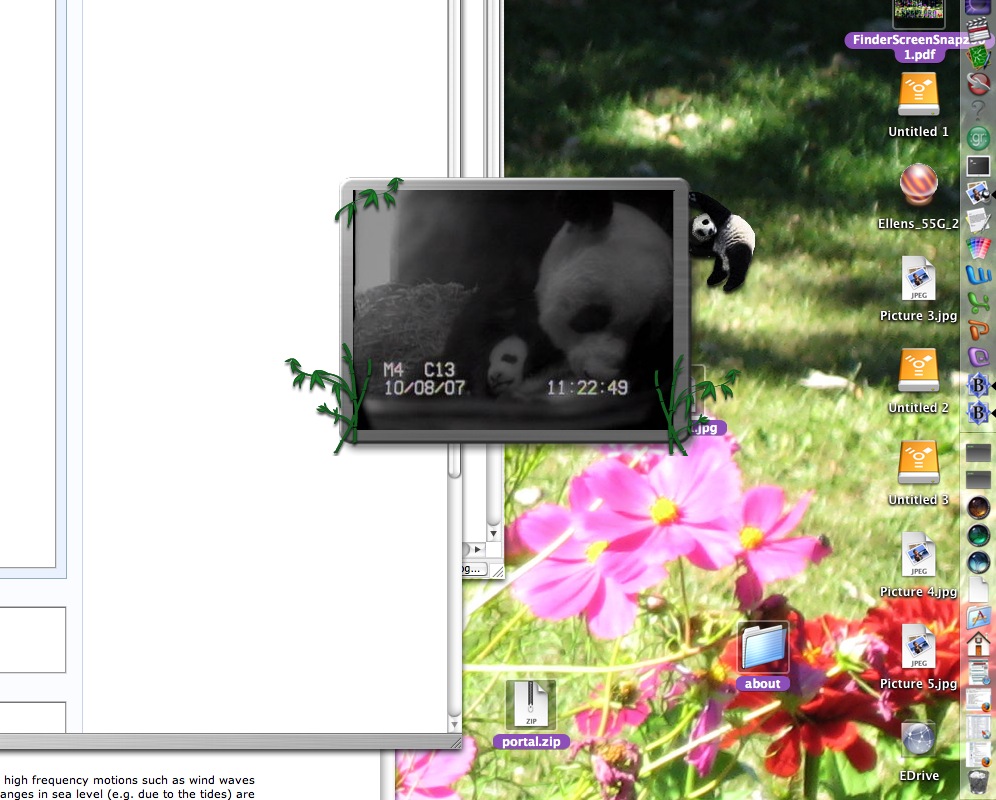
Make the pandacam show up permanently on your desktop
Thanks to Dave Taylor, I now have the PandaCam widget visible on my desktop all the time. No need to hit F12 to see if the Pandas are doing something cute.
Per Dave's instructions, just open the Terminal, and type:
defaults write com.apple.dashboard devmode YES
You should get another system prompt (">").
Then log out and log in again.
Hit F12 to show the widgets, and click and hold the one you want to have display all the time. Keep the mouse down, and press F12 again.
That's all there is to it!
October 7, 2007
A SCORM-ready template: Part 7: Embedded Perception Quizzes
Features of the new embedded quiz module:
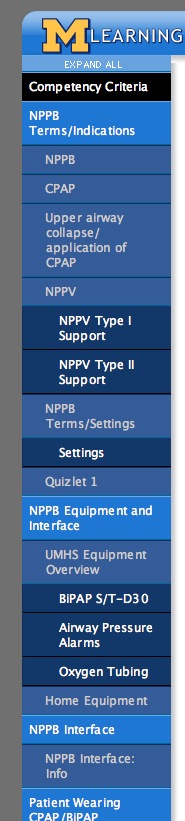
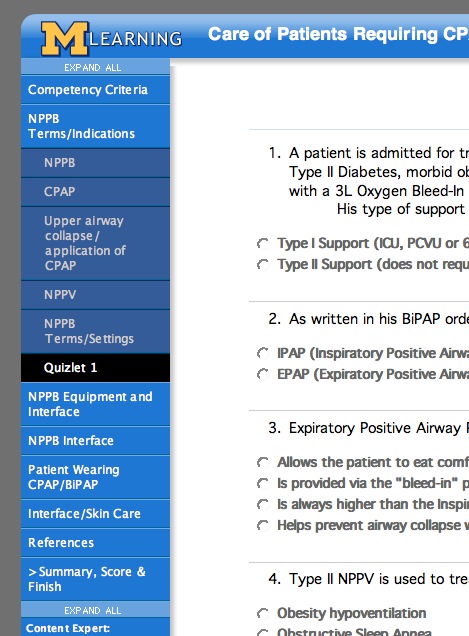
- Questionmark Perception quizzes can be interspersed among the other pages:
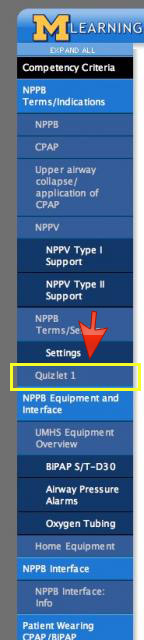
In this module, there is a quizlet at the end of the first chapter, at the second level, so it is not visible on first opening the module.
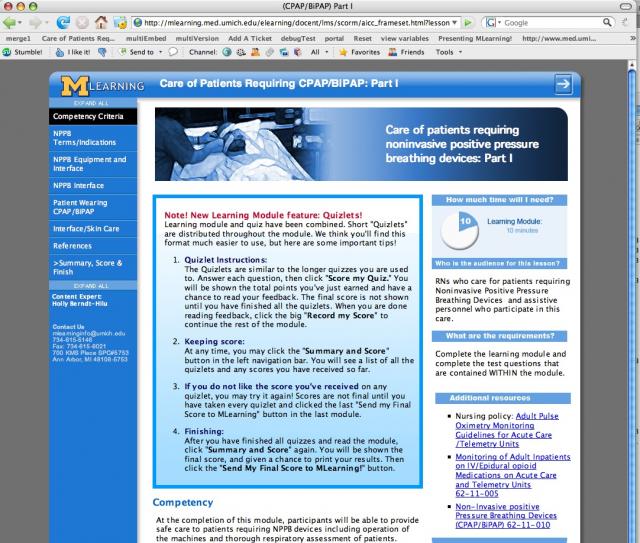
- When a user clicks a Quizlet button in the Navbar, a loading message displays:

- Then the quiz appears in an iframe on the page:

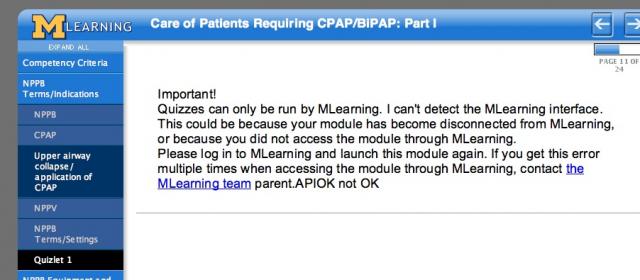
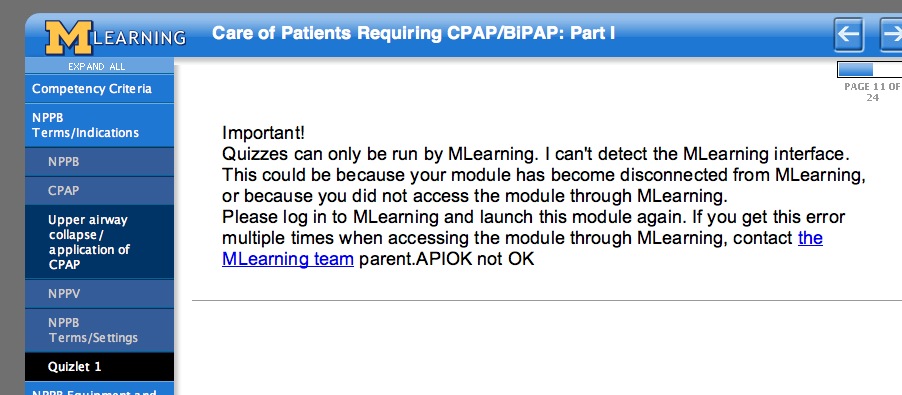
- The quizzes will only display when the module is under SCORM control, so that the module can be used as reference without going through the LMS, and users will not get a "sneak preview" of the quiz. If the module is not under SCORM control a warning message displays:
- when the user finishes answering the questions, they click the Submit answers button
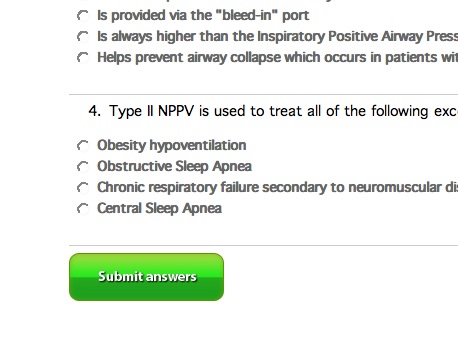
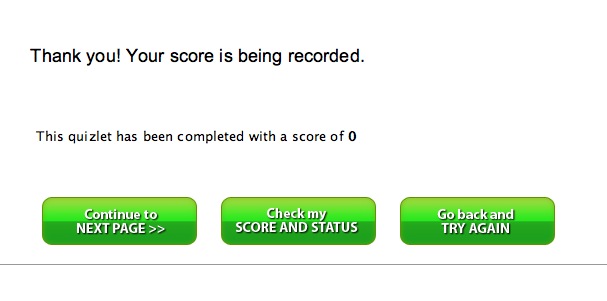
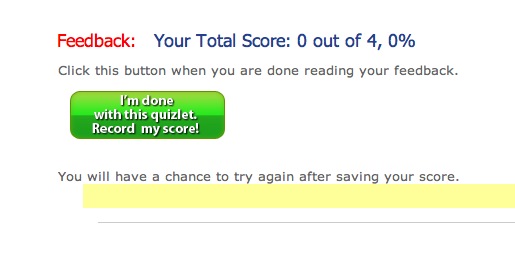
- They are shown the raw and percent score for THIS quizlet and any feedback.

- Upon completing a quiz, the user is given three options: go to next page in this module, consult the summary & score page, or try this same quiz again.
- There is a Summary, Score & Finish page which can be checked at any time. It keeps track of all quiz pages in the module, and whether they have been completed yet. The user is given the option to try any quiz again, or to go to any quiz not yet completed. They are NOT given the option to finish up and move on to the next module until this module is completed. They have the option to jump to the next module from within the "enter the lesson page" in MLearning, but this module will not be marked "Complete" until all quizzes have been taken.

- When the user clicks "try again" or simply navigates back to a quiz that was already taken, they are prompted to confirm that they want to erase their current score.
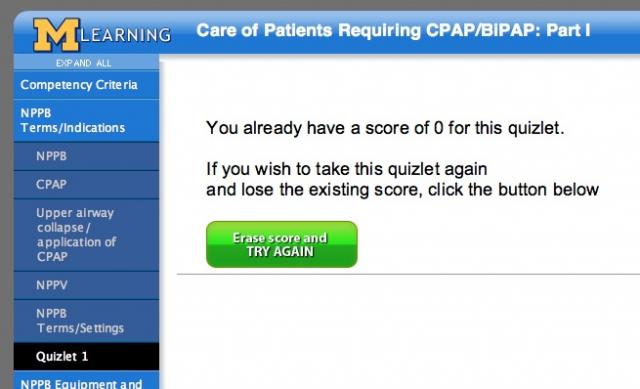
- Once all quizzes are completed, the user is shown the final outcome (Passed or Failed) and given options to improve their score or move on.

- Quizzes can be of varying lengths, can incorporate branching between blocks within the quiz, and you do not need to know up front which or how many questions will be presented when designing your module.
- Scoring is based on the total points that are actually presented after taking ALL the quizzes. The module will not complete until all quizzes have been taken. The final percentage score sent to the LMS is based on the formula:
(points earned/total possible points presented)x100
or
(raw score/maximum score)*100eg.: 4 points earned out of 12 points maximum = .33333 X 100=33%
- This template could be adapted to use quizzes of other types than Perception by having them send the necessary values to the module upon completion of each quiz. The module only requires a score and a maximum possible score for each quiz .
- The SCORM communication is all taken care of by the module.

Instructions for setting up the module:
- The main difference in setting up this learning module is in the PageArray. Questionmark quizzes are accessed using a special type of URL. An example of a PageArray set up to contain two quizzes is below:
var PageArray = new Array(
{buttonTitle:'Competency Criteria', title:' ', url:'page01.htm', chapter:0,level:1 },
{buttonTitle:'Section 1 Intro', title:'',url:'page02.htm',chapter:1,level:1 },
{buttonTitle:'Title goes here', title:'',url:'page03.htm',chapter:1,level:2 },
{buttonTitle:'Title goes here', title:'',url:'page04.htm',chapter:1,level:2 },
{buttonTitle:'Title goes here', title:'',url:'page05.htm',chapter:1,level:2 },
{buttonTitle:'Title goes here', title:'',url:'page06.htm',chapter:1,level:2 },
{buttonTitle:'Title goes here', title:'',url:'page07.htm',chapter:1,level:3 },
{buttonTitlehttp://thedesignspace.net/MT3-static/images/formatting-icons/bold.gif:'Title goes here', title:'',url:'page08.htm',chapter:1,level:3 },
{buttonTitle:'Title goes here', title:'',url:'page09.htm',chapter:1,level:2 },
{buttonTitle:'Quizlet 1', title:'',url:'includes/quizWrap.htm?call=embed&session=5338739740083895&href=http://yourperceptionserver.com/q/session.dll',chapter:1,level:2, quiz:'5338739740083895' },
{buttonTitle:'Title of p.11 goes here', title:'',url:'page10.htm',chapter:1,level:3 },
{buttonTitle:'Section 2 Intro', title:'',url:'page11.htm',chapter:2,level:1 },
{buttonTitle:'Title goes here', title:'',url:'page12.htm',chapter:2,level:2 },
{buttonTitle:'Title goes here', title:'',url:'page13.htm',chapter:2,level:3 },
{buttonTitle:'Title goes here', title:'',url:'page14.htm',chapter:2,level:3 },
{buttonTitle:'Title goes here', title:'',url:'page15.htm',chapter:2,level:3 },
{buttonTitle:'Title goes here', title:'',url:'page16.htm',chapter:2,level:2 },
{buttonTitle:'Section 3 Intro', title:'',url:'page17.htm',chapter:3,level:1 },
{buttonTitle:'Title goes here', title:'',url:'page18.htm',chapter:3,level:2 },
{buttonTitle:'Section 4 Intro', title:'',url:'page19.htm',chapter:4,level:1 },
{buttonTitle:'Section 5 Intro', title:'',url:'page20.htm',chapter:5,level:1 },
{buttonTitle:'Quizlet 2', title:'',url:'includes/quizWrap.htm?call=embed&session=7995334546622398&href=http://yourperceptionserver.com/q/session.dll',chapter:5,level:2, quiz:'7995334546622398' },
{buttonTitle:'References', title:'',url:'page21.htm',chapter:6,level:1 },
{buttonTitle:'>Summary, Score & Finish', title:'',url:'scorePage.htm',chapter:7,level:1 }
//IMPORTANT!!! the last item does NOT get a comma at the end
); //do NOT delete this final punctuation
- Each quiz page is represented by one entry similar to the one below.
{buttonTitle:'Quizlet 2', title:'',url:'quizWrap.htm?call=embed&session=7995334546622398&href=http://your.perceptionserver.com/q/session.dll',chapter:5,level:2, quiz:'7995334546622398' },
- Each entry in the PageArray contains the attributes "buttonTitle", "title", "url", "chapter", "level", and the quiz entries also contain one called "quiz".
- Replace the long number in the middle of the attribute "url" with the assessment identifier for your Perception quiz, and also add it after the attribute "quiz:"
- The last entry in the PageArray of a module with embedded quizzes must be the Summary, Score & Finish page::
{buttonTitle:'>Summary, Score & Finish', title:'',url:'scorePage.htm',chapter:7,level:1 }
- A Qpack of a sample embedded quiz can be downloaded here
- the file "embed.pip" must be called in the URL (see examples in the PageArray above
- Quizzes must use the special template MLearningEmbedinModule.template
- Each quiz should have only one outcome, in other words a single scoreband of 0-100%.
Instructions for setting up the Perception quizzes in Authoring Manager:
Note: there is a new issue with Internet explorer 7 that has required changing the way the redirect back from the quiz behaves. I'll be adding the fix in to this template soon, but for now, see this article.
October 6, 2007
iPhone "No Service" message
My iPhone started displaying a "No Service" message a few days ago. When it didn't go away, I called the ATT Wireless people. Here are the easy steps to cure the problem:
Hopefully, service comes back.
While I was waiting for someone to help me, I started the process on the Apple Support site to get my $100 Apple Store Credit for early iPhone owners. As soon as the iPhone rebooted, the confirmation message came through. Nice way to check the connection!
NOTE: December 28, 2008 - if you are here because your iphone stopped working TODAY (Dec. 28, 2008), AT&T is having problems in some states, probably related to the high winds. See this forum for more
Statuary Photoshop Brushes

Several of these brushes have been created in the negative, so that using them with light colors on a dark background will reveal only the light tones on the statue. Nice effect.
October 5, 2007
Ernst Haeckel Photoshop Brushes Set 3

High-resolution Photoshop brushes based on Ernst Haeckel's engravings of shells and sea jellies. Great used as stamps, or the spiky shells look particularly good when you use scattering and angle and opacity jitter.
October 4, 2007
Photoshop Brushes based on Ernst Haeckel's engravings: Set II

This is my second set of brushes based on Haeckel's drawings of diatoms, coral and other sea creatures. 11 different brushes are included, many with variations in opacity, spacing, size jitter, etc.
October 2, 2007
Recent research on Alzheimer's Disease
A quick survey of some of the more interesting research on Alzheimer's Disease recently:
I. Causes and Disease Mechanisms
Alzheimer's Disease Could Be A Third Form Of Diabetes
Science Daily Insulin, it turns out, may be as important for the mind as it is for the body. Research in the last few years has raised the possibility that Alzheimer's memory loss could be due to a novel third form of diabetes.Now scientists at Northwestern University have discovered why brain insulin signaling -- crucial for memory formation -- would stop working in Alzheimer's disease. They have shown that a toxic protein found in the brains of individuals with Alzheimer's removes insulin receptors from nerve cells, rendering those neurons insulin resistant. ..
...With other research showing that levels of brain insulin and its related receptors are lower in individuals with Alzheimer's disease, the Northwestern study sheds light on the emerging idea of Alzheimer's being a "type 3" diabetes.
Useful definitions for the next few articles:
is caused by an imbalance between the production of reactive oxygen and a biological system's ability to readily detoxify the reactive intermediates or easily repair the resulting damage. All forms of life maintain a reducing environment within their cells. This reducing environment is preserved by enzymes that maintain the reduced state through a constant input of metabolic energy. Disturbances in this normal redox state can cause toxic effects through the production of peroxides and free radicals that damage all components of the cell, including proteins, lipids, and DNA.
In humans, oxidative stress is involved in many diseases, such as atherosclerosis, Parkinson's disease and Alzheimer's disease and it may also be important in ageing. However, reactive oxygen species can be beneficial, as they are used by the immune system as a way to attack and kill pathogens. Reactive oxygen species are also used in cell signaling. This is dubbed redox signaling.
(from the Wikipedia article on Oxidative Stress)
Causing mitosis or transformation.
(from the
Alzheimer disease, the two-hit hypothesis: an update.
we proposed a two-hit hypothesis 2 years ago stating that both oxidative stress and mitogenic dysregulation are necessary and sufficient to cause the disease and suggested that it may be a common mechanism for other neurodegenerative diseases as well (X. Zhu, A.K. Raina, G. Perry, M.A. Smith, Alzheimer's disease: the two-hit hypothesis, Lancet Neurol. 3 (2004) 219-226). Recent developments in the field confirm some important predictions of the hypothesis and shed new lights on potential mechanisms regarding how steady state may be achieved in sporadic AD cases and therefore, in our opinion, strengthen the hypothesis, which will be the focus of this review.
Oxidative stress: a bridge between Down's syndrome and Alzheimer's disease.Besides the genetic, biochemical and neuropathological analogies between Down's syndrome (DS) and Alzheimer's disease (AD), there is ample evidence of the involvement of oxidative stress (OS) in the pathogenesis of both disorders.
The present paper reviews the publications on DS and AD in the past 10 years in light of the "gene dosage" and "two-hit" hypotheses, with regard to the alterations caused by OS in both the central nervous system and the periphery, and the main pipeline of antioxidant therapeutic strategies. OS occurs decades prior to the signature pathology and manifests as lipid, protein and DNA oxidation, and mitochondrial abnormalities. In clinical settings, the assessment of OS has traditionally been hampered by the use of assays that suffer from inherent problems related to specificity and/or sensitivity, which explains some of the conflicting results presented in this work. For DS, no scientifically proven diet or drug is yet available, and AD trials have not provided a satisfactory approach for the prevention of and therapy against OS, although most of them still need evidence-based confirmation. In the future, a balanced up-regulation of endogenous antioxidants, together with multiple exogenous antioxidant supplementation, may be expected to be one of the most promising treatment methods.
II. Diagnosis and Disease markers
Linguistic changes in verbal expression: a preclinical marker of Alzheimer's disease.
The objective of this study was to determine whether changes in verbal expression occur in the preclinical phase of AD. ...
The sample consisted of 40 healthy Spanish speakers from Antioquia, Colombia. A total of 19 were carriers of the E280A mutation in the Presenilin 1 gene, and 21 were noncarrier family members. ...
...All the participants were shown the Cookie Theft Picture Card from the Boston Diagnostic Aphasia Examination and were asked to describe the scene.
...Carriers of the mutation produced fewer semantic categories than noncarriers. In the preclinical phase of AD, changes in verbal expression are apparent and early detection of these differences may assist the early diagnosis of and intervention in this disease.
Cognitive decline in Alzheimer disease: Impact of spirituality, religiosity, and QOL....we recruited 70 patients with probable AD. ...The Mini-Mental State Examination was used to monitor the rate of cognitive decline. Religiosity and spirituality were measured using standardized scales that assess spirituality, religiosity, and organizational and private religious practices. ...
After controlling for baseline level of cognition, age, sex, and education, a slower rate of cognitive decline was associated with higher levels of spirituality (p < 0.05) and private religious practices (p < 0.005).
...There was no correlation between rate of cognitive decline and QOL. CONCLUSION: Higher levels of spirituality and private religious practices, but not quality of life, are associated with slower progression of Alzheimer disease.
September 11, 2001, and flashbulb memory in Alzheimer's disease: tool for assessing memory problems in daily practicePublic events memory" is a semantic memory that may have episodic components. One aspect involves what is called flashbulb memory, in which individuals retain vivid and detailed recollection of circumstances in which they learned of an event.
The study examined questioned 30 subjects with AD and 36 control subjects about their memory of the terrorist attacks that day. RESULTS: Subjects with AD, even those in early disease, appeared to have less detailed recollections of the event, in terms of evocation, dating, and responses to questions. They also had flashbulb memories associated with it less often than controls (46% of cases compared with 97.3% of the control subjects). DISCUSSION: The excellent performance of control subjects underlines the memory impairment about this event in patients with AD. Questions about this topic may be a good tool for general practitioners assessing the need for further evaluation in patients with memory complaints.
Conscientiousness and the Incidence of Alzheimer Disease and Mild Cognitive ImpairmentBy Judith Groch, Senior Writer, MedPage Today
A neat orderly mind augmented by a conscientious personality tends to resist Alzheimer's disease, researchers here found.
Self-disciplined and goal-directed persons who scored high on a standard measure of conscientiousness had an 89% lower risk of developing Alzheimer's than those with low scores, Robert S. Wilson, Ph.D., of Rush University, and colleagues, reported in the October issue of the Archives of General Psychiatry.Epidemiologic research has shown that conscientiousness is associated with a wide range of mental and physical disorders, disability, and death, suggesting that the trait has some general role in health maintenance, the researchers said....
...Because mild cognitive impairment is increasingly viewed as a state that precedes clinically evident dementia in Alzheimer's, the researchers conducted a further analysis. They found that a higher level of conscientiousness was associated with a reduced risk of mild cognitive impairment (HR, 0.977, 95% CI, 0.956-0.999).
...There are several ways conscientiousness might protect against Alzheimer's disease, the researchers said. Controlling for cardiovascular health and lifestyle activity patterns did not substantially affect the findings, they found.