November 19, 2005
Preventing Page Shift to left in Safari and Firefox
My home page has a lot of columns - the less important ones are usually beyond the right edge of the page in a small screen. In Safari and Firefox that creates an unpleasant page "jump" or shift to the left when the page first loads. Instead of seeing the navbar and main articles, the page shifts so the content on the far right is within the page.
I found a cure for this behavior here: Getting Rid of the Page Shift
Adding this to the style sheet fixed it:
/*this is to keep page from shifting to left on load in safari and firefox*/

html { min-height: 100%; margin-bottom: 1px; }

html { overflow: -moz-scrollbars-vertical !important; }
November 12, 2005
Modern Origami and Polyhedral Sculpture
Origami artists have taken the field to new heights over the last few years.
See some of the best of recent modern origami art here., along with links to more information about each artist.
See also Richard Sweeney's blog on art and architectural origami"Paper and Form
Build your own world with Groboto
Groboto, the best little 3D program that no one knows about, lets you grow machines like coral, animate organic forms, create a new world.
Not only does Groboto allow you to create marvelous 3D creations, animations and games, but it has fun audio feedback for everything you do, so it beeps and burbles at you as you work.
For more information about Groboto, click here


My Gallery on Deviantart.com
My artwork is here on DeviantArt.com. Take a look, leave a comment, leave links to your own galleries - I'd love to see them.


Visit "Museum of my favorite artists"
This virtual museum is an ever-changing scrapbook of my favorite artists. It is the kind of art collection I would like to build.The museum is online for my personal use and educational use only. Wherever possible I will provide links to sites or books where you can find more information about each artist. When I have been able to contact the artists, their permission has been requested, and noted on the page. If you are one of the artists, and have NOT given me permission, please contact me to get a formal request.
TO ENTER THE MUSEUM, CLICK HERE
Fair use: All images are copyright of the artists or sites they are stored on. More information on the relevant parts of fair use rules are HERE.
Outside In: Outsider Art and Crafts Renew the Fine ArtsWith the opening of The Folk Art Museum, the American Visionary Art Museum, The American Craft Museum, and others like them, museum curators have affirmed a broader definition of art. Or perhaps a better description is that they have attempted to follow a shift in the mainstream of creativity. No matter what, it is certain that any collection of contemporary art will have to include objects from all the arts, to include the best of what is being created today.
It's hard not to notice the astonishing creativity in the decorative and commercial arts in the last decade: stamping and paper crafts, polymer clay, multimedia, graphic design, illustration, calligraphy, furniture and industrial design, and even in comics, graffiti, tattooing, and action figure design.
A few years ago, the term "outsider art" was coined to denote any style that did not fit within the traditional confines of the fine arts. But within a few years, the phrase has already lost much of its original meaning as it broadens almost daily to include more and more.
A sense of the difficulty of pinning down just what is "outside" and what is "inside" is seen at the various museum sites,
when their mission statements all encompass a page or more of floundering
between styles, education or psychiatric condition of the artist, and
intended use.
Perhaps it's time to consider the possibility that like a moebius strip,
the outside IS now the inside. Just as Duchamp and Picasso indicated
so long ago, and as most other cultures have known for ages, art is
where you see it.
The copyrighted works shown here are presented under the Fair Use Provision of the Copyright Act. This Provision states
"§107. Limitations on exclusive rights: Fair Use"Notwithstanding the provisions of sections 106 and 106A, the fair use of a copyrighted work, including such use by reproduction in copies or phonorecords or by any other means specified by that section, for purposes such as criticism, comment, news reporting, teaching (including multiple copies for classroom use), scholarship, or research, is not an infringement of copyright. In determining whether the use made of a work in any particular case is a fair use the factors to be considered shall include -
- the purpose and character of the use, including whether such use is of a commercial nature or is for nonprofit educational purposes;"
- the nature of the copyrighted work;
- the amount and substantiality of the portion used in relation to the copyrighted work as a whole;" and
- the effect of the use upon the potential market for or value of the copyrighted work.
"The fact that a work is unpublished shall not itself bar a finding of fair use if such finding is made upon consideration of all the above factors."
Related Links
American Visionary Art Museum
American Folk Art Museum
American Craft Museum
RawVision E-Zine
November 7, 2005
Imitation Behavior in Fish
One of the more amazing characteristics of fish is their ability to learn by imitation. I've noticed imitative behaviors in all of my fish, including goldfish, parrot cichlids, convict cichlids, severums and oscars. Although they come out of the egg already knowing how to swim, how to eat, and how to hide, they add new behaviors as they grow.
Learning attitude: Parrot Cichlids
When young parrot cichlids are put in a tank by themselves, they will usually remain shy for weeks or months. They will hide behind anything they can. If there is nowhere else to hide, they will hover at the top corner of the tank tipping downward slightly, pretending to be part of the filter. However, if they are put into a tank with adult parrot cichlids who have no fear of humans, they get over their shyness very quickly! When we got one of our younger parrots, "Baby," she immediately adopted the oldest parrot cichlid Winston (a female) as her "mother." She would follow Winston around, and generally imitate everything she did, and as a result showed very little fear of us.
But most of our newly acquired parrot cichlids spend at least a day or two hiding, during which they peek out from a secure spot to observe what's going on in the tank.
When we got "Tonkie," "Twinkie" and "Micro," as tiny fry, you could actually see them watching the older fish eating from our hands. Within a few days, they were right up front also, jockeying for position to get the best flakes. They will often push at my fingers if I don't feed them fast enough, as if to say "turn on the flakes!"
Learning feeding behaviors: Parrot Cichlids
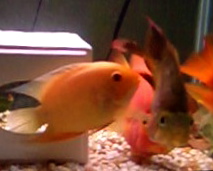 "Tonkie" figured out a pretty good feeding spot all for himself: he eats the flakes that collect on the intake. After I feed them, there's usually a nice selection held there by the suction, and he can pick them off at his leisure. He's quite conscientious about his job: there are 3 intakes in the tank which he cleans daily. Tonkie is too fat to get behind the intakes, but he cleans the fronts thoroughly. Everyone else in the tank leaves him alone: as far as they are concerned, he can have the intakes. Or at least that was the case, until we introduced "Opal," a gold severum, into the tank. After a few days of watching Tonkie, Opal had learned to eat off the intakes, and what is more, she could eat off the BACKS of the intakes, because she is thinner. At first, there were many disputes between Opal and Twinkie over the intakes, but now they have learned to share, most of the time.
Learning feeding behaviors: Goldfish
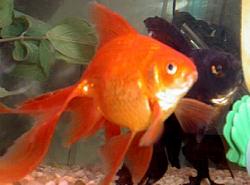 Goldfish also learn by imitation, despite the fact that they think very differently than cichlids. I call them "non-linear thinkers" because they seem to forget where they are going every few seconds then pick up the thread again. This results in a meandering path. Our goldfish eventually arrive at a goal, but not without stops and distractions along the way.
Yet goldfish definitely learn new behaviors from each other. When we first got "Piggum," a little fantail goldfish, he would eat only off the surface of the water. He would paddle back and forth across the tank all day long, never showing any interest in the gravel. After Piggum was settled in, we found "Magoo," a telescope-eye moor. When we dropped Magoo into the tank, Piggum didn't know what to do. He put his head down on the ground and just sat there for a long time. Piggum doesn't have much overhead for coping with change.
But Magoo didn't seem to mind Piggum at all! He immediately got to work checking the gravel for food. Magoo had a real work-ethic. He would systematically go over the entire tank, turning over every piece of gravel. Piggum watched him for a long time. After a few days, HE started checking the gravel also! After that, they would do it together.
As they got older, and Magoo could actually fit several pieces of gravel into his mouth, he learned to use them as "teeth" to chew his food. Lagging behind by several months, Piggum eventually picked up that behavior also, but never using gravel to the degree Magoo did.
Learning to get along
Recently we got a tiny new parrot cichlid, "Taz." Taz is named because she is obviously cut out to be trouble! She is a King Kong parrot, which can mean a much more aggressive personality, with the ability to bite (many parrot cichlids can't), and not afraid to use it. When Taz got into the new tank she started out hiding, as most of them do. She was quite scared of us, and had been traumatized by an experience with an oscar. It was an inauspicious beginning. She would startle at the least noise, and race into her log.
Soon however, Taz began poking her head out to defend her tiny territory. She would run up to other fish aggressively, trying to intimidate them. She did all the things convict cichlids do, both defensive and offensive behaviors, against fish many times her size. Her little mouth works very well, and we were afraid there would eventually be nipped fins and tails.
But as time went on, we would see her watching the others. The bigger parrot cichlids don't fight too much, and when fights do break out, another fish usually busts it up after a few minutes. Sometimes we would see Taz stop in mid-bad-behavior to watch what the others were doing. It's been a few months, and she has mostly stopped fighting, and joined the community. She also shows no more fear of us, although she still startles easily, but she always returns immediately back to the front of the tank. We often see her watching the older fish.
I always find it fascinating to watch our fish learn new behaviors. They are more intelligent than usually given credit for, but it is harder to see what they are doing than with a dog or cat, and so it is difficult to notice when they make a tiny "leap" from one concept to another. But the leaps are definitely there - and worth the effort to see.
November 6, 2005
SSL for some files, not for others
Certain applications work poorly under SSL: the back button may not function, or users' security settings may be such that they are constantly presented with various certificate errors.
Suppose you have a web application which should not be run under SSL, but needs to have secure sections, such as credit card payment or the login. One way to handle this would be to reload the page upon entering and exiting a secure section of the application.
On an IIS server, to set this up, you must first create an SSL certificate. Ordinarily, if you were going to require that SSL be used to access all or part of your site, you would open the IIS manager, right-click a site or directory in the IIS console and choose Properties.
Under the Directory Security tab and choose "Edit" in the Server Certificate section. Then you would check the "Require SSL" checkbox.
If you do NOT check this box, you still have the option for accessing any page in the site with SSL, simply by using https in the URL. However what if your users accidentally get there using an http prefix? You can enforce the url through client side or server side scripting, depending on what you prefer. With client-side javascript you need to be careful, because it can be shut off in the browser.
For more on enabling SSL, see this article