Before I visited the Georgia Aquarium, most of what I used to know about cuttlefish included the fact that they can be purchased neatly packaged in dried chewy form in Japanese groceries. So, I was very surprised when I first met one face to face in the Georgia Aquarium and realized they are remarkably intelligent creatures.
Cuttlefish are invariably curious about people, and will come up and try to get a better look if you catch their eye. They are precision swimmers, able to hover motionless near an object of interest by rippling their skirt of fins, only to suddenly jet off in another direction using their funnel siphon when they have seen enough.
They are equally curious about other cuttlefish - even images of cuttlefish - as the video below by Brian Leahy demonstrates. In the middle of the video, the videographer turns the camera's display around to face the nearby cuttlefish which inspires an immediate darkening response, and causes all the other cuttlefish in the tank to start moving purposefully toward the camera.
An article by Brenna Lorenz describes an encounter with cuttlefish and humans who had the idea to match the gestures made by the cuttlefish with their tentacles. The Cuttlefish of Sentosa (Sentient Cephalopods), by Brenna Lorenz
The ability of cuttlefish to instantly mimic the color and texture of their environment, particularly the area underneath them, is well known but little understood. They use a layer of chromatophores and a layer of iridiphores (reflective cells) [Meet the Cuttlefish] which are revealed when chromatophores contract as well as detailed muscular control to create visual and textural illusions.
The textures and colors they imitate are so complex that it led me to wonder if cuttlefish use only their eyes as the sole inputs for processing visual information. In other words, if their eyes are covered, can they still mimic their surroundings? Several recent articles present evidence that their eyes are indeed the main sensors. Cuttlefish eyes have been determined to be colorblind, but are sensitive to the orientation of polarization of incoming light. One study determined that contrast is one of the main visual cues used to determine the pattern of camouflage.
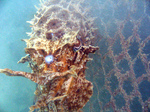
Cuttlefish mimicking a net trap
(I don't have an attribution for this photo yet)
Their visual patterning is used for communication as well as camouflage, and even sometimes for hypnotizing their prey [ A Dazzling Show.]
These visual signals have been analyzed and found to have a signal capacity of approximately 3 bits per signal - enough for some primitive communication, if not an actual language in the human sense of the word.
Cuttlefish are Cephalopods and belong to the superorder Decapodiformes which includes all species with ten limbs. (8 arms and 2 tentacles.)
More information:
Cuttlefish Taxonomy:
- Kingdom: Animalia
- Phylum: Mollusca
- Class: Cephalopoda
- Subclass: Coleoidea
- Superorder: Decapodiformes
- Order: Sepiida
- Order: Sepiida
- Superorder: Decapodiformes
- Subclass: Coleoidea
- Class: Cephalopoda
- Phylum: Mollusca

I have a squid story that happened while snorkling. We came across a line of squid just hanging in the water. There were a dozen or so and they were lined up side by side so if you were facing the line all of them were looking right at you. They weren't in a bunch or randomly ordered. They were in a line. I approached the line from the front right. When I got to about 6 feet from them, the squid at the right end of the line flashed about 10 different iridescent colors very rapidly. The squid to his (her) left, then flashed the same pattern, then the on to the left flashed, and so on down the line. When the information got to the last squid in the line, they all turned 180 degrees, squirted black ink and flew away.
All of the color changes from the beginning down the end through the turning and running took about 2 seconds. They went through probably every color in the rainbow with the colors traveling across their bodies from head to toe: red, blue, green, yellow. I don't really remember the colors or the order, but it was beautiful to see and an obvious means to coordinate an escape with as much ink in the water at one time as possible.
They were not just randomly flashing colors and running in panic. They were timing their escape together.
Posted by: barbara on December 12, 2007 4:40 PMWow, what a great story! Thanks for posting that. They're incredible creatures.
Posted by: Ellen on December 12, 2007 9:27 PM